

Technology
How To Create Enterprise Value with Technology In B2B
In the industrial B2B world of manufacturing, distribution, wholesale, and industrial services, technology has shifted...

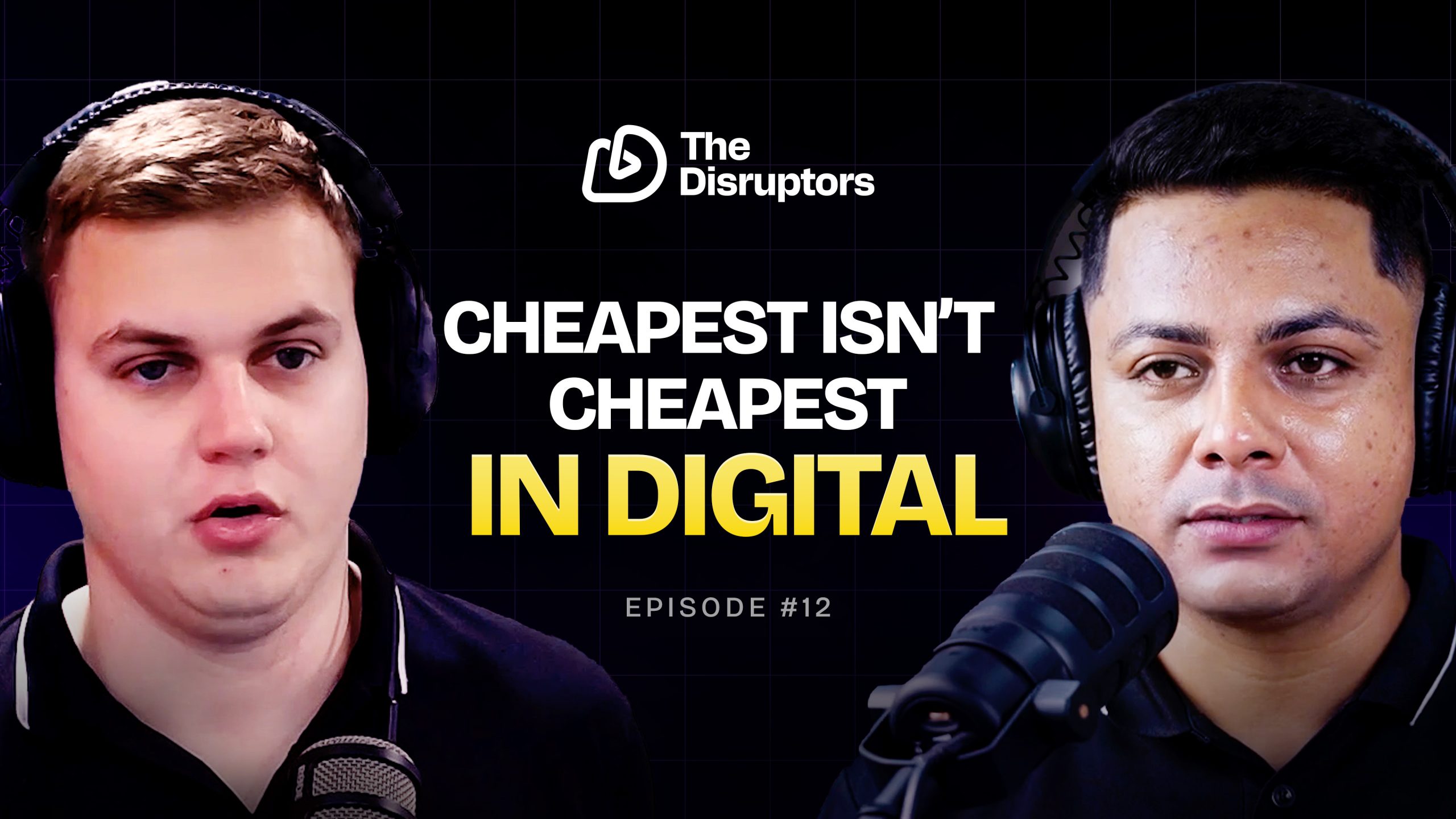


Show: The Disruptors Episode: 12
Publish Date: 29 September 2025
The harsh truth – in digital transformation, the cheapest quote often becomes the costliest mistake.
Most digital projects that “save money” up front end up costing more — because the cheapest vendor rarely delivers the right outcome.
In this episode of The Disruptors, Ritesh Shah and Julian Wallis unpack why procurement decisions based on price create technical debt, wasted spend, and failed transformation. They explain why the lowest bid is usually the most expensive, and how to evaluate partners who actually deliver on Profit, Scale, and Value.
00:45 – Procurement is more than paperwork – why vendor choice matters
02:10 – Lessons from big companies losing millions with the wrong partner
03:45 – Aligning on the real problem before chasing tech solutions
05:15 – The “checklist” trap: treating projects like commodities
06:35 – Cheapest-first decisions and the hidden cost of technical debt
08:20 – Vendors experimenting on the client’s budget
10:20 – Why misaligned assumptions doom projects from the start
12:00 – Building trust and confidence in procurement decisions
13:20 – Buying brains, not just build capacity
15:00 – Discovery as an investment, not a sunk cost
17:30 – PSV Thinking™ applied to procurement (Profit, Scale, Value)
19:30 – Why higher upfront investment delivers better long-term returns
21:00 – Moving from vendor relationships to trusted partnerships
22:15 – Closing insights: the cheapest quote usually costs the most
Julian Wallis, CEO at Intuji (00:00:00:00 – 00:00:08:14)
A lot of people think that a five-page document with some bullet points and things is enough to get an accurate reading on a project, which it’s just not.
Ritesh Shah, CTO at Intuji (00:00:08:14 – 00:00:15:20)
They have choose a wrong vendor or technical partner rather than a problem-solving engine. It became a technical debt for the company.
Julian Wallis, CEO at Intuji (00:00:16:01 – 00:00:25:00)
If you’re looking at investing in a longer-term digital transformation initiative, then firstly, we’ve got to focus on the problem and get clear on actually what we’re trying to solve.
Ritesh Shah, CTO at Intuji (00:00:25:01 – 00:00:31:01)
If you don’t see the long-term vision and then the attitude is not right, then you are looking at the problem?
Julian Wallis, CEO at Intuji (00:00:31:01 – 00:00:50:20)
They’re trying to do it on a shoestring budget, and then they wonder why they end up with something that just looks terrible. Doesn’t work. All right. Welcome back to another episode of The Disruptors. Good to be back. And, doing it a bit different this week. I’m starting off. So. Yeah, I appreciate you taking the time to join.
Julian Wallis, CEO at Intuji (00:00:50:22 – 00:00:51:17)
Ritesh.
Ritesh Shah, CTO at Intuji (00:00:51:19 – 00:00:57:14)
Thanks for Julian. Good to be back. I really enjoy this kind of conversation.
Julian Wallis, CEO at Intuji (00:00:57:16 – 00:01:00:00)
It’s been a while.
Ritesh Shah, CTO at Intuji (00:01:00:03 – 00:01:02:01)
Yeah, it’s been a while.
Julian Wallis, CEO at Intuji (00:01:02:03 – 00:01:38:00)
So. No. It’s good. Good. Well, today we’re just going to discuss just around, I guess, the procurement or partnering, whether it’s private or government, kind of internal champions. People that are leading up digital transformation initiatives or it’s website redevelopment software builds, app builds, whatever you want to call essentially digital transformation in general, but kind of the individual internal champions or teams that are leading up those initiatives and just how imperative and how important it is for those people to, make sure that they are clear on what they’re trying to achieve.
Julian Wallis, CEO at Intuji (00:01:38:00 – 00:02:02:22)
And, you know, I guess support them to find the right partner. Because as we know, time and again, working through these processes is that a lot of the time, these teams or individuals may not know a lot about kind of, not always, but, they may not know a lot about digital transformation or I guess, being able to compare apples with apples, if that’s the way we want to put it.
Julian Wallis, CEO at Intuji (00:02:03:00 – 00:02:21:13)
With these projects and I guess, and what’s your experience of some of the stuff that we’ve had come to us, whether it’s kind of RFQs or more just in general, kind of higher level discovery, where I guess, what have you seen from teams about, you know, changing direction and not really knowing even, I guess, what the problem is they’re trying to solve.
Ritesh Shah, CTO at Intuji (00:02:21:17 – 00:02:49:16)
With this almost 15 years of experience, I’ve seen projects going up and down and then basically I’ve seen clients have come up to us with a lot of problem with a lot of technical debt. Basically, they have to choose a wrong vendor or technical partner, and they use the promise of big shiny thing. And then later on it was rather than a problem-solving engine, it became a technical debt for the company.
Ritesh Shah, CTO at Intuji (00:02:49:18 – 00:03:23:15)
And they I’ve seen like big, big companies like that, like investing 5 million more than that. And then they have after two years time, they have decided, this is the wrong way. So basically, the way we think the PSV lens we have is the first approach I see in any problem solving skill, actually, we have to, does the, first identify the problem, and then we see where we can make a better profit, scale and create some value around it.
Ritesh Shah, CTO at Intuji (00:03:23:17 – 00:03:54:04)
So basically I’ve seen a lot of companies, a lot of tenders as well, and all that kind of thing where people are have a lot of technical debt and sometimes people go even I’ve seen clients go for select for cheaper vendors they won’t always want cheaper solution, which has caused them to become more expensive in long term, actually, because maintaining that, maintaining that cheaper solution is biggest hurdle actually.
Julian Wallis, CEO at Intuji (00:03:54:06 – 00:04:23:04)
Yeah, it’s not only maintaining it though, it’s not even like, a lot of the time that we’re not even achieving what we wanted to, what we set out to achieve and what we were trying to achieve, which means that it’s kind of a failed project in general. Right. And there’s so much, I guess, is the importance of, of who you work with, and making sure that they actually understand your organisation or the business in the industry and can actually help you identify the right problem to solve.
Julian Wallis, CEO at Intuji (00:04:23:06 – 00:04:48:22)
And then come up with the right solution to solve that. And again, sounds cliche, but it is so, so, so important. And as you’ve said, we’ve seen, I guess, wrong technical implementations, which is, you know, understandable. Well, to a degree, like as in that there is there’s some technical choices sometimes that don’t work out, etc., but that is still something very important.
Julian Wallis, CEO at Intuji (00:04:49:00 – 00:05:06:20)
But I guess even further than that, there’s like further back than that, I guess is the way to put it, is that there’s not always, I guess, the right solution from the very beginning of even focusing on the right areas, the right problem. And again, as you said, we’ve seen this through so many, I guess procurement or what do you want to call this?
Julian Wallis, CEO at Intuji (00:05:06:20 – 00:05:26:08)
Sales cycles, working with different companies, private government, whatever it is, and it’s our job as a partner to actually help them identify what the right thing to do is. So much of the traditional approach is, Oh, yeah, here’s what you want to do. He’s a bullet point list. Yeah. Here’s a, here’s a quote or here’s whatever.
Julian Wallis, CEO at Intuji (00:05:26:08 – 00:05:52:08)
Let’s do it. Thanks very much. See you later. And it’s just, it’s ticking a box, right. It’s doing it for the sake of doing it. It’s a oh yeah, we’ll tick a box. And I guess it’s somewhat viewed as, a commodity or. You know what I mean? Like, it’s viewed as a. Oh, yeah, we’ll use that for a year or two years and whatever, we’ll scrap it and we’ll get rid of it and whatever we’ll do, you know, do it again.
Julian Wallis, CEO at Intuji (00:05:52:10 – 00:06:07:16)
And to me, I don’t know, I guess you need to treat it a bit like working with an architect or a construction partner for a large-scale building, right? You don’t just put out a few points and, you know what I mean, put out a few ideas and say, oh, you know, this is what we’re going to do.
Julian Wallis, CEO at Intuji (00:06:07:16 – 00:06:27:02)
We’re going to do it as cheap as possible and we’re going to do this and we’re going to do that. And yep, we don’t need any other help. Thank you very much. And the irony of it is, is probably that people know within reason this might rile some people up, but people probably know more about construction in general, because it’s physical and they actually do about digital or tech.
Julian Wallis, CEO at Intuji (00:06:27:04 – 00:06:38:06)
And yet with tech, they seem to think they can prescribe. This is exactly what we’re going to do, and this is exactly how we’re going to do it, even when they may not have the knowledge to be able to do that.
Ritesh Shah, CTO at Intuji (00:06:38:08 – 00:07:13:18)
This is what I’ve seen actually, is they, for small websites like a company blog, website or company info website kind of thing. WordPress has always been a good solution, easy solution, best solution. Is, is the security vulnerabilities is there. But still, if it is maintained strongly, WordPress has always has been the best solution. But these days, all the vendors are always pitching modern stack or anything.
Ritesh Shah, CTO at Intuji (00:07:13:21 – 00:07:36:20)
Modern stack is like react in the front end and then everything. Basically, if it’s a very small project and very small solution, I would always recommend going with WordPress. And if it’s a, the vision is big and then if the, if the budget is there to scale and maintain the project, then the modern stack would be give them more flexibility around the scalability.
Ritesh Shah, CTO at Intuji (00:07:36:23 – 00:07:59:04)
I get that, but every of the solution these days, the newbies, because with the AI generation, everyone is from the the day one, a developer. So this is the popular thing, lets implement this. The experiment is going on the client project actually they’re learning and on the go on the project. And that’s what is happening all the time actually.
Ritesh Shah, CTO at Intuji (00:07:59:04 – 00:08:22:17)
That’s why, experiment, I love experiment, doing experiment, but to what level? To what extent we are? It is like, is the idea is great, experiment should be done. I also agree with that because until and unless we don’t experiment. We don’t know new things, but risking the client’s money and the client’s vision, the big vision could be a big deal.
Ritesh Shah, CTO at Intuji (00:08:22:17 – 00:08:55:00)
Actually, that’s what I’ve seen on a couple of projects where, they have choosed a very, the vision was big and, but the, it’s done halfheartedly. One of the, one of the projects that I was reviewing a couple of weeks ago, I felt that actually. Okay, this, you, the plan was big, but the idea was the vision was big, but the, the implementation was so crap that it has to be redone again and again.
Ritesh Shah, CTO at Intuji (00:08:55:00 – 00:08:59:19)
So this kind of project come to us of quite often.
Julian Wallis, CEO at Intuji (00:08:59:21 – 00:09:13:20)
Yeah. And I guess its the importance, as you said, is the importance of finding that. Right partner. And to be honest, it comes down to trust and like a lot of, I guess.
Julian Wallis, CEO at Intuji (00:09:13:22 – 00:09:33:10)
Unfortunately, sometimes or a lot of the time, probably is a way to put it, the procurement decisions are made based on looking at the numbers and thinking people are comparing apples with apples, rather than going on okay, who seems to be the most trustworthy? Who’s put in the most effort of demonstrating to us that this is how we will get the results?
Julian Wallis, CEO at Intuji (00:09:33:10 – 00:10:00:16)
This is how we will get our solution. And again, it’s the same thing, is that it’s, there’s no there’s no such thing as I guess, necessarily what’s the word? There’s no one way to do something right in these particular scenarios. And it’s not there’s not, you know, there could be even just the problem in itself. What we’re trying to solve can be solved multiple ways.
Julian Wallis, CEO at Intuji (00:10:00:16 – 00:10:21:03)
The tech stack, the variables that are all everything that’s there, there’s, there’s millions of different ways essentially eventually to get to the end outcome. I think I guess my, my focus for this episode more was, you know, what, what I wanted to, to discuss and was trying to give advice to anyone out there is just getting the confidence and clarity around the partner that they work with to.
Julian Wallis, CEO at Intuji (00:10:21:03 – 00:10:39:22)
Implement this, is that, there’s certain projects, you know, if it’s, if it’s quick and it’s nasty, let’s call it that way, you know, you might go for the cheapest solution. You might know that that is whatever. We don’t care. It’s a, it’s you know, it’s a it’s a six month thing. We don’t care how it’s built. It’s going to be destroyed after six months.
Julian Wallis, CEO at Intuji (00:10:40:00 – 00:11:07:18)
Yes. Okay. That’s we’re not talking about that scenario. If you’re looking at investing in a longer term digital transformation initiative, anything like that, then you’re really, really have to to, I guess, build that relationship with that vendor. Get the trust there and understand, I guess the biggest thing for me is like, okay, forget the actual tech stack necessarily, or that’s don’t get me wrong, that’s important as you’ve discussed as well.
Julian Wallis, CEO at Intuji (00:11:07:18 – 00:11:35:19)
And it’s important that we get to those things. But firstly we’ve got to focus on the problem and get clear on actually what we’re trying to solve. And I guess to explain a little bit what that means and the dive into that, because you said that a few times, it’s like how many people come to us with, with an idea or a vision and a maybe even a wish list of this is what we want to do is, yeah, etc., that when we actually analyse it honestly, more than half doesn’t need to be done in one instance.
Julian Wallis, CEO at Intuji (00:11:35:19 – 00:11:54:16)
So they’ve come up and I’ve said, we’re going to do all of this stuff and when we analyse, it’s like, well, it’s actually not going to bring any return. So as you said, PSV Thinking, profit, scale and value or vice versa, they come to us thinking like building the most advanced amazing system. And it’s just the bare basics, right?
Julian Wallis, CEO at Intuji (00:11:54:16 – 00:12:13:12)
It’s like, you know, they’re building a customer portal or their building an application that does this and this, and it’s like, they think it’s this amazing system. And it’s like, well, have you spoken to customers? Have you spoken to users? Have you done this? And they’re like no, we just put this out and we’ve already got ten quotes or we’ve already got five quotes.
Julian Wallis, CEO at Intuji (00:12:13:12 – 00:12:19:02)
It’s like, it’s pretty hard to fix the problem when you’re solving the wrong problem.
Ritesh Shah, CTO at Intuji (00:12:19:04 – 00:12:43:18)
Exactly. Exactly. It, basically what we were discussing, I was thinking in my head that, okay, selecting as a vendor is also similar to getting married. Selecting your life partner. Actually, if you are, you have to be if someone is not passionate. Right. But how do you select the you look for the attitude. Do look for the character? You are.
Ritesh Shah, CTO at Intuji (00:12:43:19 – 00:13:04:07)
If you don’t look the, you see the long term vision in the life partner. If you don’t see the long-term vision, and then the attitude is not right, the passion is not right, then look how they are solving, how they are looking at the problem is also very, very important for selecting a vendor, not only on the Excel sheet.
Ritesh Shah, CTO at Intuji (00:13:04:09 – 00:13:28:04)
If Excell sheets makes these kind of decisions, then it’s the wrong decision, wrong way to make it. Yes, there is, there is that proof. But Excel sheet here I mean is, the cost only perspective. I don’t, the cost is second, second, second or last thing. But it’s the attitude. It’s the perspective how we take the problem, take the challenge as our own.
Ritesh Shah, CTO at Intuji (00:13:28:06 – 00:13:37:17)
It’s not ok, it’s a client job. And so it’s not that. If we take it as our job then yeah, it’s the second thing that, last thing would be money I guess.
Julian Wallis, CEO at Intuji (00:13:37:20 – 00:14:01:18)
Yeah I couldn’t agree with you more. I think one of the well to me the, one of the biggest things people are buying, reserving whatever you want to call it when they work with someone like ourselves, is how do you put it? You’re the brains, the intellect, the innovation, the thought process, the mindset. Right? Because to a degree, writing a function is a commodity, if that makes any sense.
Julian Wallis, CEO at Intuji (00:14:01:18 – 00:14:24:02)
So to a degree, if there’s enough of a requirement put down, then yes, anyone can write that function within reason. Yes, there’s different levels. Yes there’s absolutely but within reason it’s a, that’s the commodity. For example, if we know exactly what we need to do, the easy bit is building it. Right. The problem is figuring out what do we exactly do.
Julian Wallis, CEO at Intuji (00:14:24:02 – 00:14:47:16)
And that isn’t just like, yes, there’s technical decisions need to be made. What tech stack do we use? What the technologies that we use? Do we integrate other existing infrastructure that we need to work with, whatever that is? That’s all important. But on top of that, it’s like, where do we actually even focus? Coming back to that PSV Thinking to get the most increased profitability, eg., increasing opportunities, decreasing costs, increasing our scale.
Julian Wallis, CEO at Intuji (00:14:47:16 – 00:15:08:05)
So how do we scale further to the customers then? How do we build enterprise value? And again, if you that is the hardest bit in any organisation, whether it’s private, government, whatever it is now, obviously the PSV Thinking applies a little bit differently to government, but it’s the same principles, right? How you’re building citizen value, right, rather than enterprise value.
Julian Wallis, CEO at Intuji (00:15:08:05 – 00:15:32:08)
So you’re bringing value there. And we’re increasing the scale to, you know, so we can deliver far more services with the same headcount, for example, then how do we reduce our cost? Right. Make sure, total ownership over time. That doesn’t mean investment is low. It doesn’t mean we cut budgets in half and things like that there. But we invest, for example, it’s better that we invest 2 million.
Julian Wallis, CEO at Intuji (00:15:32:08 – 00:16:01:13)
Now, and over five years we invest 3 million and we get 15 million or 20 million in return from what we’ve done. Then investing 500,000 now and writing that off in two years time has a failed project, right? But again, the hard bit is, and I just say this for ourselves, in knowing our industries, that how we show that to people and building that trust is just incredibly important.
Ritesh Shah, CTO at Intuji (00:16:01:15 – 00:16:37:23)
Exactly. Yeah. Basically the other thing also is experience also, like, if you are selecting a vendor, then they or he or she, whatever the company is, has to be a very experienced one as well. I’ve seen the people not understanding the vision, not seeing the vision. Just, just whatever is like assigned to is, they are just do that only, basically that what I want to say actually. Reading between the lines and understanding the vision is very, very important.
Ritesh Shah, CTO at Intuji (00:16:38:00 – 00:17:05:16)
Basically what happens is that with clients they see the problem. This is the problem. I want this data to come here, but a really experienced vendor, what they will look into is why? Why they want this data to be moved from here. The process, the thought process will be different. And then they will approach the problem in a different way. How, like, basically I have seen in five years time.
Ritesh Shah, CTO at Intuji (00:17:05:16 – 00:17:25:09)
People are building small, small, small applications here and there, and in five years’ time the data is scattered so bad that none of this is useless in the today’s AI world like, they are, they have all the data, but it’s scattered everywhere.
Julian Wallis, CEO at Intuji (00:17:25:11 – 00:17:45:10)
Yeah, there’s no, no single management. And again, and I guess it comes back to the planning, the discovery of and there’s no, you’re never going to have everything perfect. That’s not really the point. There’s no single silver bullet. There’s no perfect way. But I guess it it comes back to the management and making sure you’ve got the right competent people working on the project that can actually do what you need to do.
Julian Wallis, CEO at Intuji (00:17:45:12 – 00:18:05:08)
And to me, I honestly feel a lot of people underestimate the difficultness of these kind of projects. Like they think. I’ve often said this, but like they underestimate how much something is going to cost as in they think it’s, typically, not always, but they typically underestimate, you know, the level of investment required. But they also at the same time, they underestimate the power.
Julian Wallis, CEO at Intuji (00:18:05:08 – 00:18:22:00)
If it’s done properly, they underestimate the returns if it’s done properly. It’s both. So they underestimate what’s going to take to actually invest, to do it properly and vice versa. They underestimate, you know, what the returns are. And typically, the one of it is they underestimate how much it’s going to cost to do it properly. That’s the main one.
Julian Wallis, CEO at Intuji (00:18:22:05 – 00:18:46:11)
A lot of people say, yeah, we know what tech can do. We know what this can do. And you know, we’ve got all these great ideas and they, they’re trying to do it on a on a shoestring budget. And then they wonder why that they end up with something that just looks terrible, doesn’t work, doesn’t function, etc.. And doesn’t, I guess, get the results they want.
Julian Wallis, CEO at Intuji (00:18:46:11 – 00:19:08:16)
And to me, a lot of it comes back to again. I’ve harped on about it a bit, but is, is the discovery right? Is like, if we’re not doing thorough discovery, if we’re not getting aligned on what the roadmap is, what the plan is, what the strategic plan is, what the strategy is then how do we know what we’re going right, if that makes any sense.
Julian Wallis, CEO at Intuji (00:19:08:18 – 00:19:31:14)
And just on that and zeroing in on this point, I’d like your comments on this, is a think for me. This is both a vendor thing. And, you know, when we’re working with organisations, but there’s often a lot of assumptions, right? For example, an organisation will assume that a vendor that they’re working with, our partner they’re working with will be like, oh, they get what we’re saying.
Julian Wallis, CEO at Intuji (00:19:31:14 – 00:19:52:21)
Yeah, we’ve already done our flowchart. They totally understand what we’re trying to say. It’s like, well, I’m not really, like as in, we need to know a lot more than that. We need to understand a lot more on that and vice versa. Vendors will think, Oh yeah, I’ve said this two sentence thing, so they know that. I mean, this other six other things, if that makes any sense.
Julian Wallis, CEO at Intuji (00:19:52:23 – 00:19:56:19)
A lot of it comes down to misalignment and misunderstandings, right?
Ritesh Shah, CTO at Intuji (00:19:56:21 – 00:20:34:02)
Yeah, exactly. I think I’ve seen one of the clients come to us with, I want this website to be redesigned, this, this, this, this. But we went way through to analyze the vision, going through the lines of the requirements. What we saw the vision was much more bigger than a replatform redesigning kind of thing. His vision was, his words were just to redesign, but the vision was to, very big. We, if someone says, just a redesign, what would they say?
Ritesh Shah, CTO at Intuji (00:20:34:04 – 00:20:57:12)
Oh, he doesn’t like the color. He doesn’t like the alignment or whatever that is. What do I understand? That is what I understand. Right. So it isn’t like. But he’s with and before after looking at the requirements for an hours, we decided, okay, this project needs a proper discovery. We need to understand the proper vision.
Ritesh Shah, CTO at Intuji (00:20:57:14 – 00:21:23:05)
These two lines won’t give us a proper context on what we want to, where we want to. And basically, we got to that point because like, if we don’t do a proper discovery, we won’t architect it properly. We are seeing a very smaller picture. And then we are architecting the application in that, according to that smaller picture.
Julian Wallis, CEO at Intuji (00:21:23:08 – 00:21:51:08)
Well thanks everyone. We’ve run into some technical difficulties, but just to wrap it up, it’s so, so important that whoever you work with, the partner and vendor or whatever you want to call them, that you’re aligned, is that trust there. As we’ve said, touched off, discovery is so important. The previous episode as well, where I had a chat with Ashish about that, as well as to how important, you know, alignment is and in in discovery and making sure that we’re crystal clear and on the same page, it’s kind of all flows into the same thing.
Julian Wallis, CEO at Intuji (00:21:51:08 – 00:22:12:04)
Is that a lot of the time, people can write off discovery. They don’t want to necessarily put in the extra investment. They don’t see it as being necessary. A lot of people think that, you know, a five-page document, with some bullet points and things is, is, enough to get an accurate, reading on a project, which is just not.
Julian Wallis, CEO at Intuji (00:22:12:04 – 00:22:35:17)
And again, it’s not necessarily anything to do with their fault. It’s just how do we get clear, how do we get aligned and get on the same page? And there’s, I feel there is a misunderstanding or really there’s a lack of education around the fact of how much work goes into, into these projects and how much work is needed to, to make sure that we get a successful outcome.
Julian Wallis, CEO at Intuji (00:22:35:18 – 00:22:53:00)
And it’s not guaranteed, it’s something that has to be worked on. And so we would strongly advise, as we discussed in this episode, build that trust, get clear, and don’t just look at the budget. Don’t just look at the numbers. You need to look at what are we doing, what are we solving and what’s the potential return.
Julian Wallis, CEO at Intuji (00:22:53:02 – 00:23:02:01)
And make sure that we’re aligned on that. And then again, we can work towards a successful outcome. Appreciate you tuning in once again. And, we’ll see you again next week. Thank you.
Ritesh Shah, CTO at Intuji (00:23:02:03 – 00:23:30:20)
That’s a wrap on this episode of The Disruptors. If you are serious about unlocking your EdgeFactor®, the thing that sets your business apart and helps it grow sustainably. Don’t forget to follow, share and leave a quick review. We will be back next week with more real-world insights and no fluff conversations on how to rethink your systems, modernise operations, and build value that lasts.
Ritesh Shah, CTO at Intuji (00:23:30:22 – 00:23:35:01)
Until then, stay safe, stay focused, and keep disrupting!

September 29, 2025