

Technology
How To Create Enterprise Value with Technology In B2B
In the industrial B2B world of manufacturing, distribution, wholesale, and industrial services, technology has shifted...

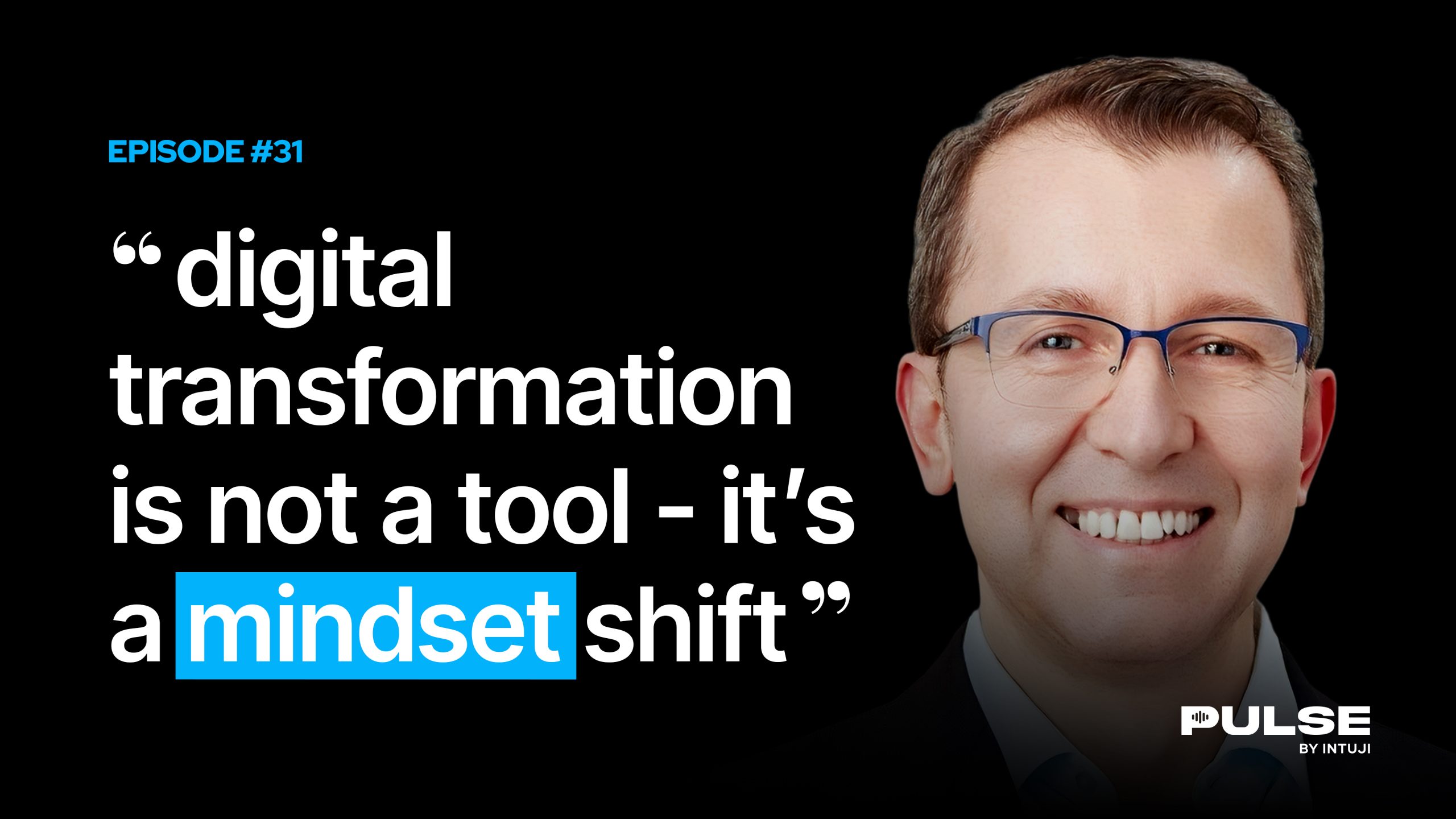


In this episode of Pulse by Intuji, Julian Wallis sits down with Nick Eshkenazi, a global digital transformation leader with 25+ years of experience helping organisations rethink how they work, lead, and adapt.
Nick explains why transformation has little to do with technology and everything to do with mindset, agility, and leadership behaviour. He breaks down how the most successful organisations shift focus from predicting the future to building the ability to adapt fast. This conversation unpacks how empowered teams, servant leadership, and continuous improvement create organisations built for resilience — not reaction.
00:00:00 – Introduction
Julian introduces Nick and the theme: why mindset and agility outshine technology in transformation.
00:06:33 – What “Digital” Really Means
Why transformation fails when it’s treated as a tool rollout instead of a cultural shift.
00:08:39 – Agility and Adaptability
Nick’s approach to helping organisations embrace uncertainty and build flexibility.
00:13:27 – Aligning Work with Strategy
How frameworks like OKRs keep teams focused and accountable.
00:17:49 – Servant Leadership
Why the best leaders exist to enable their teams’ success.
00:21:32 – Transformation Is Not a Checklist
The trap of vanity projects and box-ticking in digital initiatives.
00:24:12 – Building Agility as a Core Capability
Why adaptability is the true measure of progress.
00:28:59 – The Three Cs of Change
Nick’s formula for lasting transformation — Communication, Collaboration, Co-creation.
00:36:12 – Democratising AI Skills
How empowering people accelerates innovation and adoption.
00:40:30 – Final Reflections
1% improvement each day compounds into extraordinary progress. Key
Visit our learning centre for more product management, design, and innovation resources.
Catch the full episode and others at the links below, or find us wherever you listen to your favourite podcasts:
➕ YouTube – https://www.youtube.com/@pulsebyintuji
➕ Spotify – https://open.spotify.com/show/34jThbSZ1iVcEF93Tey6dy
➕ Apple Podcasts – https://podcasts.apple.com/us/podcast/pulse
➕ Deezer – https://www.deezer.com/en/show/1000801452
Also, give us a follow on the platforms below to keep up with the latest from Pulse by Intuji:
👉 LinkedIn – https://www.linkedin.com/company/pulse-by-intuji
👉 YouTube – https://www.youtube.com/@pulsebyintuji
👉 TikTok – https://www.tiktok.com/@pulse.by.intuji
👉 Facebook – https://www.facebook.com/pulsebyintuji
👉 Instagram – https://www.instagram.com/pulsebyintuji
👉 X/Twitter – https://twitter.com/pulsebyintuji
👉 Website – https://pages.intuji.com/pulse
INTRODUCTION
Nick Eshkenazi, CDTO at Astellas Pharma (00:00:00:00 – 00:00:08:12)
If you hire smart people, as we all try to, and then you give them the problems, but you also give them the solutions. Then why do you hire smart people?
Julian Wallis, CEO at Intuji (00:00:08:13 – 00:00:14:00)
Just be prepared to change, going down the wrong track just because we’re not prepared to change, right?
Nick Eshkenazi, CDTO at Astellas Pharma (00:00:14:05 – 00:00:18:16)
If change is hard, everything else will be harder. It’s as simple as that.
Julian Wallis, CEO at Intuji (00:00:18:18 – 00:00:27:18)
If no one feels ownership or being part of the solution, then essentially it’s like forcing that change or pushing people into something that they may not even have a proper understanding of.
Nick Eshkenazi, CDTO at Astellas Pharma (00:00:27:20 – 00:00:36:18)
If you are in leadership in the world of technology, focus on not just what you’re doing, but how you’re doing it.
(00:00:36:20 – 00:01:02:08)
Nick Eshkenazi is an award-winning chief digital and transformation officer with over 25 years of global experience in technology, data and operations. Recognised as CTO of the year 2024 – 25 and one of the top ten CTOs in APAC. Nick has held key leadership roles across major global brands, including Woolworths, Astellas Pharma, Costco, Fanatics, USAA, and JPMorgan Chase.
(00:01:02:10 – 00:01:11:01)
He’s a visionary in AI, agile transformation, and digital innovation. Join us for our conversation with Nick Eshkenazi.
START OF EPISODE
Julian Wallis, CEO at Intuji (00:01:11:03 – 00:01:22:10)
Excited to have you on the podcast, Nick. We’ve been organising this around for a while. We’ve had a few, technical issues here and there getting it sorted, a few reschedules, but, excited to, to get, get it underway finally. Thanks for coming on.
Nick Eshkenazi, CDTO at Astellas Pharma (00:01:22:12 – 00:01:25:16)
Julian. Thank you. Thank you for having me. A pleasure.
Julian Wallis, CEO at Intuji (00:01:25:18 – 00:01:46:20)
No worries. It’s, I’m excited to, to get into all the questions. I know you’ve had a long, long career. I know you’ve, had multiple roles across multiple companies as well as different countries, etc.. So why don’t you give us a bit of a background of your career to date? I know it’s been a while and there’s been quite, a quite a few different roles, but, summarise it for those that may not be familiar with you.
Nick Eshkenazi, CDTO at Astellas Pharma (00:01:46:22 – 00:02:31:22)
Yes. Thank you. Look, I’ve been really privileged, over the years to, you know, work for the greatest company on the planet and, through, through those endeavours to also, reside and function in many different locales. I’m currently in Australia, and for the last seven years. But, it all, as I look back, happened through some really special inflection points, that I, you know, I kind of borrow that term, but I call them the sliding door moments that often occur, in our lives.
Nick Eshkenazi, CDTO at Astellas Pharma (00:02:31:22 – 00:03:07:20)
And it’s, we all ask ourselves, is this a door that I need to walk through, or is this a door that I need to kind of let close and and so those doors, some of them have, have created, some exciting opportunities to join, a journey, over the last, 17 or so years, out of the 25 plus, that I have, helped organisations in, in different capacities.
Nick Eshkenazi, CDTO at Astellas Pharma (00:03:07:22 – 00:03:42:23)
I have focused on, enabling digital capabilities and transforming, the organisations through the power of digital, but also through the power of revised and augmented ways of working, mindset and operating models. And all of those things combined have brought about different level of performance, execution, delivering value both for customers, and for the stakeholders, for those entities, if you will.
Nick Eshkenazi, CDTO at Astellas Pharma (00:03:42:23 – 00:04:06:08)
And again, looking back, it’s, it’s been, really special to, and a privilege to, to be a part of, of many of those companies and as a result, to help them on their journey. But also, to, to further my own. And so hopefully that helps. And I’m sure we’ll double-click and deep dive into some of those.
Julian Wallis, CEO at Intuji (00:04:06:10 – 00:04:20:00)
Yeah. Yeah, absolutely. And I appreciate that. Well, what first got you into it, I guess, as in, you know, digital transformation is made up of a lot of things. Right. But I guess, where did you, where did you start? Like, where were you, what what led you into where you are today, I guess?
Nick Eshkenazi, CDTO at Astellas Pharma (00:04:20:02 – 00:04:47:08)
Yeah. Well, I probably resembled the standard profile that, that, you’ve probably heard or interacted or met a lot of people that followed. But, you know, I have this, you know, I grew up in Europe and, and, you know, remembering I was quite bored through school and I wanted to finish as fast as possible. And so I finished my masters in, in, in one year versus the normal two program.
Nick Eshkenazi, CDTO at Astellas Pharma (00:04:47:08 – 00:05:19:05)
And I was fairly young and, and wanted to wrap things up and wanted to go and just make a difference. You know, when we’re young and in our early 20s, we, we, we wake up in the mornings like, I can change the world. I know I can, and, and then so I started basically as a software developer after, graduating, with my masters in computer science and, and started kind of helping with different exciting initiatives and projects.
Nick Eshkenazi, CDTO at Astellas Pharma (00:05:19:05 – 00:05:45:23)
But they all had this moment of attraction of, there was something innovative. We’re doing something that doesn’t exist. And one thing kind of leads to another. And you meet people, and there’s like, wow, I’m excited of what you’re working on. Can you bring that to where we are? And, and so, that led me through different countries.
Nick Eshkenazi, CDTO at Astellas Pharma (00:05:46:01 – 00:06:14:16)
And ended up in the United States, and, work for, the two organisations there. A very, one of the most successful, I would say, financial services company on the planet USAA, in, in Texas. And then, I was working for Paccar, in the state of Washington. And in both cases there, you know, my role, had to do something.
Nick Eshkenazi, CDTO at Astellas Pharma (00:06:14:16 – 00:06:44:14)
Which strategy, direction, execution. But, but always a big component of that was creating things that never existed before, or involving innovative solutions that create new value. So from, from those times is what I’ve kind of crafted of looking to create something that doesn’t exist through technology, a new way of life, a new process, a new interaction channel.
Nick Eshkenazi, CDTO at Astellas Pharma (00:06:44:16 – 00:07:07:19)
From that time, I clearly remember I know it’s not new news today, but the, the first organisation and it happened during my time there that launched an ability to deposit a paper cheque, through a mobile device was USAA. Yeah. There was a time when paper checks were still in use, and people were struggling to find a banking branch.
Nick Eshkenazi, CDTO at Astellas Pharma (00:07:07:19 – 00:07:37:14)
And so the first company that ever the launched, that was USAA, and and I was a part of that innovation, and it was always opportunities like that to drive something new and exciting that, changes companies, changes industries, changes how we do things. You touched on in your question, you touched on something, and I know we’ll unpack it a lot more.
Nick Eshkenazi, CDTO at Astellas Pharma (00:07:37:14 – 00:08:20:06)
But often, often companies talk about, or individuals even talk about digital transformation. And when, when you hear the term digital, you normally think of technology, data process, or a new tool that I need to adopt. My experience, Julian has shown that, is a lot more than that. And, and a statistic now has been proven that, across many digital transformation that it’s, that it’s more importantly, its, its something else and that is, that, how we do things, how we execute is often more important than what we get done.
Julian Wallis, CEO at Intuji (00:08:20:08 – 00:08:42:00)
Yeah, yeah. I couldn’t agree more with you. And I’d like to dive in, to dive into that a bit, bit further. I think on the cheque side, that’s interesting. I remember when I was very, very young, one of my first, bank accounts. I do remember having a, as a young, young kid, having a, paper chequebook, but that was very quickly eradicated.
Julian Wallis, CEO at Intuji (00:08:42:02 – 00:09:08:16)
And, it was an interesting, interesting experience, I will say. But, I’ve grown up mostly with my life, with technology, and I’ve seen probably the earlier stuff, and grown up through to where we are now. And it’s just fascinating. I guess if you were, kind of 40 years ago to say what we’ve got available from, even from a hardware perspective and a software perspective today is just, I guess, probably couldn’t even be fathomed and where the next 40 years is going to go.
Julian Wallis, CEO at Intuji (00:09:08:16 – 00:09:28:13)
Well, no one really knows. Well, no one really knows. But diving a bit deeper into what you’re talking about, then I think two of your big points are, is a mindset. And the operating model shift right there, two of the key key pieces of of this and I, I totally agree with you, but a lot of my experience, with it is that people absolutely, as you say, they look at digital transformation as a tool.
Julian Wallis, CEO at Intuji (00:09:28:19 – 00:09:48:02)
We’ll just put a tool in and that’s how it works. Whereas, 100%, it’s it’s so much more than that and a lot of, a lot of the role and the job is the strategy, the innovation part of it. And actually, but coming up with how are we going to change how we do things, not just, oh, we just implement an off-the-shelf tool or a fit-for-purpose tool or something, and magically it just solves the business.
Julian Wallis, CEO at Intuji (00:09:48:06 – 00:09:50:01)
So give us a bit more insight on that.
Nick Eshkenazi, CDTO at Astellas Pharma (00:09:50:03 – 00:10:19:04)
Yeah. So the, the how piece, we, we often forget it and, and we say, hey, let’s maybe even bring some consultancies or, or go buy a solution from a third-party vendor. And yes, that is absolutely a viable approach. However, the most critical things that have been proven now quite successfully are that, we all realise that the future is unpredictable.
Nick Eshkenazi, CDTO at Astellas Pharma (00:10:19:06 – 00:10:45:01)
And, and as much as we try to predict it, it’s not going to happen. It’s changing fast in front of us. As a result, the mindset that I’ve adopted is one of agility and adaptability. Instead of spending our time and energy in predicting the future, which, trust me, in my past, I, I was always trying to be that person who was trying to predict the future, and I consistently failed.
Nick Eshkenazi, CDTO at Astellas Pharma (00:10:45:03 – 00:11:18:06)
So instead of doing that, I spend the majority of my time now is to help organisations to transform in a way that allows them to be more adaptive and more agile than ever before. And, and normally what that means is but bringing the agile mindset, but also changing the ways of working and the, the ways of working on a daily basis is one of the most critical, you know, approach to take in order to facilitate a successful digital transformation.
Nick Eshkenazi, CDTO at Astellas Pharma (00:11:18:07 – 00:11:52:11)
In reality, that, what that looks like is, organising your operating model around the core solutions, products or processes and creating small cross-functional teams that include the capabilities. And I use the term capability to mean the human skillset and the tools that those humans need to be successful, and owning that product solution, service or a process end-to-end throughout its life cycle.
Nick Eshkenazi, CDTO at Astellas Pharma (00:11:52:13 – 00:12:19:12)
They are accountable, then for the innovation that they can introduce in the product. They are accountable for running that product or operationalising it, fixing any incidents or problems or bugs that may occur. Understanding feedback from their customers on their ongoing basis, knowing who the customer for that product is, and continuously evolving that solution for the benefit of the customer.
Nick Eshkenazi, CDTO at Astellas Pharma (00:12:19:14 – 00:12:40:05)
And so you can apply this principle to almost anything that you can think of. And, and so creating small cross-functional teams around product solutions and services and aligning the operating model around that cross-functional entity, those agile teams that create value all the time.
Julian Wallis, CEO at Intuji (00:12:40:07 – 00:13:12:20)
Yeah. I think that’s, that’s fan… fantastic advice. And obviously we can dive into that a bit, bit deeper. But, I guess high level with, you’ve work with a lot of, I guess, boards, executives in large companies, in a range of companies across different industries, all that kind of thing. One thing from, from my experience, that I’ve seen is that a lot of people don’t actually understand what’s possible. And I guess there aren’t, you know, people think differently, they don’t understand what’s possible when there’s a lot of like, we’ve always done it this way or we we tweak something here or we tweak something there for us to get those big gains without
Julian Wallis, CEO at Intuji (00:13:12:20 – 00:13:35:03)
just implementing vanity projects or, you know, just shiny objects, whatever. How do we actually, yeah, what’s your advice and your experience for working with those boards and demonstrating, I guess, a business case or an idea? Where does that, do you see that typically comes from, where it’s like, okay, we’ve figured out what we need to do, and now we figure out we need to figure out how we need to do it.
Julian Wallis, CEO at Intuji (00:13:35:03 – 00:13:53:06)
But, I guess a lot of those, not all of them, clearly, but I say a lot of, you know, people that aren’t involved in the day to day of of the tech side and understand that I guess what’s possible and aren’t connecting the dots with the actual the work side, the operating model side, how do you go about helping them understand that?
Julian Wallis, CEO at Intuji (00:13:53:07 – 00:13:55:15)
Or what’s your approach on that? Or advice?
Nick Eshkenazi, CDTO at Astellas Pharma (00:13:55:17 – 00:14:38:00)
It’s a really good one. Julian, to unpack, the couple of couple of reflections that are on on your question. One, one critical piece is to really keep in mind that it’s important that the digital agenda, the, the technology enablement strategy is always, 100% in its possibility, aligned with the company strategy. And, and you ensure that by, if possible, adopting, you know, performance management and objective management frameworks, things like, for example, the OKR framework which, which I’m a big fan of, it’s OKR stands for objectives and key results.
Nick Eshkenazi, CDTO at Astellas Pharma (00:14:38:02 – 00:15:11:13)
And it really, it helps on an annual basis to define here is what we, you know, we’re asking to achieve. And those are ambiguous or, or, you know, very ambitious objectives sometimes. And then how you measure them, if you’ve achieved them is through the tangible key results against them. And then you incorporated also quarterly planning throughout that cycle to be able to say, here’s what I’m going to achieve the next 90 days against my annual objectives.
Nick Eshkenazi, CDTO at Astellas Pharma (00:15:11:15 – 00:15:33:06)
And then at the end of the 90 days, you pause, reflect, retrospect, and see what worked well, that I continue to replicate it. And what didn’t. Then I need to stop it or change it, and then you try it again for the next 90 days, for the next quarter with the goal is, always continuous improvement and becoming better by practicing, by trying new things, by learning.
Nick Eshkenazi, CDTO at Astellas Pharma (00:15:33:08 – 00:16:00:06)
And so ensuring that, I demonstrate how the things that every cross-functional team that we just discussed earlier has their own OKRs aligned with the company OKRs at all time. It’s very critical. And if they’re working on something that they cannot demonstrate how what they’re, you know, delivering is aligned with those OKRs. Maybe we just need to challenge them and encourage them to realign.
Nick Eshkenazi, CDTO at Astellas Pharma (00:16:00:07 – 00:16:23:01)
And so, that’s the first piece of the puzzle is, you know, adopting company wide a framework like OKRs and then ensuring that every day on an every, every basis, you know, every person on the team, a small team, a hub, a larger entity is has all of their objectives and key results are aligned to the to the company overall.
Nick Eshkenazi, CDTO at Astellas Pharma (00:16:23:03 – 00:16:49:04)
The, the second component of it is and I and I touched on it, but I cannot emphasise on how important that is, is adopting that mindset of continuous improvement. Creating solutions that, you might have heard the term before, is there always ready to be consumed, but they’re never complete. They’re always in the state of evolving and getting better and maturing.
Nick Eshkenazi, CDTO at Astellas Pharma (00:16:49:06 – 00:17:12:10)
You know, they’re like the solution that you and I are using right now for, for this podcast. It’s, it’s in a state of continuous maturity. New features will be always created. It will get better, maybe new filters, maybe there will be an AI, you know, component of it very soon that would allow us to capture real-time notes as those things are coming in.
Nick Eshkenazi, CDTO at Astellas Pharma (00:17:12:10 – 00:17:36:02)
And so, whoever owns the solution as a team continues to improve it. But at this moment of time, it’s consumable. How do I know? Because you and I are using it. So it’s always consumable. But it’s also not always in the state of continuously improving. So, adopting this principle of aligning what you’re working on with the company objectives, number one.
Nick Eshkenazi, CDTO at Astellas Pharma (00:17:36:04 – 00:17:45:11)
And second, striving for continuous improvement through the life cycle of the product that you own.
Julian Wallis, CEO at Intuji (00:17:45:13 – 00:18:05:02)
Yeah, very good, very, very good advice. I guess, my next question would lead on from here is, seeing experience I’ve seen and stuff as well, is that even when we, when we get that we’re doing that reporting and stuff, a lot of this seems to be blocked, you know, by decisions getting signed off by, executives or whatever.
Julian Wallis, CEO at Intuji (00:18:05:02 – 00:18:24:05)
We want to call it, bureaucracy, whatever it is. There’s not that empowerment there for the teams to actually continue moving. And sometimes the expectation can be, and as, I think me and you well know, is that, you know, it’s not necessarily a linear process from A to B, right? It’s very much not that. We have to change things. We adapt our strategy. As you said, continuous improvement.
Julian Wallis, CEO at Intuji (00:18:24:07 – 00:18:45:23)
It’s never perfect in that regard. Where, you know, we know the objectives, you know, the key results. But we don’t know exactly how we’re going to get there. Right. We might need to change our strategy, change our approach, within reason as we as we are trying to achieve those things. So how do we make sure that as teams that are leading this, that we’ve got that trust and that we’re empowered to, to move forward?
Julian Wallis, CEO at Intuji (00:18:45:23 – 00:19:00:00)
And I guess what would you say to any of the managers, leaders, executives, whatever, we want to put it out there that, that have got teams under them that are working on these things and helping them understand this, this, I guess process.
Nick Eshkenazi, CDTO at Astellas Pharma (00:19:00:02 – 00:19:48:06)
Yeah. It’s, look, a very, very big question and, not an easy one, because it goes to values, culture, behaviours within the organisation. And that often the leadership dictates that. So how we approach it, is a critical piece. I would say that, based on experience, unless the, executive team, the leadership team, anyone in management aligns with that mindset of, I am here to enable others success.
Nick Eshkenazi, CDTO at Astellas Pharma (00:19:48:08 – 00:20:16:05)
It will be a struggle. There is this, you know, and it has been coined in the management and leadership frameworks over the years, but there comes a moment in everyone’s career where they have to ask for answer for themselves. Would I continue to grow and, and and evolve my personal technical capabilities in, individual contributor capacity, or do I want to become a manager?
Nick Eshkenazi, CDTO at Astellas Pharma (00:20:16:07 – 00:20:45:12)
We live in a world that most people see seniority and growth as becoming a manager. But often people don’t get trained on what it means to be a good manager. And may I suggest that that switch is critically important at the moment you decide to become a manager, you recognise that you, from that point on, exist for the success of others, and your success is dependent upon their success.
Nick Eshkenazi, CDTO at Astellas Pharma (00:20:45:14 – 00:21:16:06)
And many people are not able to make the switch. And that’s a critical piece. And so for me, subscribing to the approach of servant leadership has been the way to really make that transition is if you think of, you know, they the individual contributors are working for you. I would say it’s more of, an erroneous approach to the problem, not the right way to look at it.
Nick Eshkenazi, CDTO at Astellas Pharma (00:21:16:09 – 00:21:44:14)
But if you look at it slightly different, which is you work for them, you work for to enable their success, you ask curious questions. They are normally, how can I help you? Or what should we do differently? Or how do we approach this in a different way? Or how can I personally assist you to be faster, better, more cost-effective, more efficient and then allow them to solve it, allow them to come up with the solutions?
Nick Eshkenazi, CDTO at Astellas Pharma (00:21:44:16 – 00:22:10:00)
You know, if you hire smart people, as we all try to, and then you give them the problems, but you also give them the solutions, then why do you hire smart people? So create big problems for sure, but then hand it over to good, solid cross-functional teams and ask them to come up with the solutions. You can challenge them.
Nick Eshkenazi, CDTO at Astellas Pharma (00:22:10:02 – 00:22:19:16)
You can ask curious questions around them, but allow smart teams to come up with the right solutions for big problems.
Julian Wallis, CEO at Intuji(00:22:19:18 – 00:22:43:09)
Yeah, I think it’s fantastic advice. And we need, we need, I guess, intelligent, innovative people leading these initiatives. And I would say some of the experience that we’ve had is just seeing, teams is that some of the teams are approaching like the digital transformation as a, a box ticking exercise, a checklist, if that’s the way that we want to put it.
Julian Wallis, CEO at Intuji (00:22:43:09 – 00:23:06:15)
And I know we’ve touched off on a little bit already, but it’s not, it’s absolutely not that. You know, if you think that implementing a new dashboard and implementing a new tool with digital transformation, just from my perspective, you couldn’t be further from from what it actually is meant to be, rather than just getting deep down into one of those OKRs as a company.
Julian Wallis, CEO at Intuji (00:23:06:15 – 00:23:37:19)
But then how do we change our way, as you said, our way of working. And so what are your your, I guess, unpacking that a little bit more as to identifying what we’re doing as, probably not the right word, but vanity or just doing for the sake of doing it, if that’s the way we want to put it, versus measuring the things that we’re actually moving the needle on without being cliche, but we’re actually genuinely driving change and, and, you know, substantial growth and, advancement for the business I guess.
Nick Eshkenazi, CDTO at Astellas Pharma (00:23:37:21 – 00:24:13:08)
Yeah, I know we touched on this a little bit, but let’s, let’s further deep dive. Organising around product services solutions and, and processes is is critical. Creating those small and I emphasise on small because when, when the size of those cross-functional team exceeds kind of 12 – 13, then it becomes harder to operate. And then literally staying out of their way and, and being there to support them when they need help removing obstacles.
Nick Eshkenazi, CDTO at Astellas Pharma (00:24:13:10 – 00:24:40:12)
Supporting them financially if they need budgets and the like, and then really participating in their own, ways of working in, in the agile mindset is called ceremonies, things that they do being a daily stand up or grooming their backlog or the work that’s getting done, or proactively planning for the next quarterly cycle so that they can align their OKRs with the company.
Nick Eshkenazi, CDTO at Astellas Pharma (00:24:40:12 – 00:25:18:03)
OKRs as you said. The, you know, we’re touching on something that’s critically important is because, again, back to what we discussed earlier, Julian, because anyone who tells you that they can predict the future, unless it’s a company, they’re actually creating the future, they can’t really predict what’s going to happen. The, the only the only way to really do this, the, in, from a futuristic standpoint to create sustainability and resiliency for the organisation that I know, is to focus on one of the most important capability that the organisation should have.
Nick Eshkenazi, CDTO at Astellas Pharma (00:25:18:05 – 00:25:53:05)
And I know it may sound more like a play of words, but it is not that. And the capability that I’m emphasising on is the capability of agility. Becoming adaptable, becoming agile as an organisation is the most critical capability to focus on. Because when you’re in an environment when you cannot predict the future, and there are external and internal forces that would impact your strategy, would impact your direction, is to really be able to adjust and course correct as fast as possible.
Nick Eshkenazi, CDTO at Astellas Pharma (00:25:53:05 – 00:26:17:06)
And the only way to do that for large or medium size or larger organisation is to be able to focus on being agile and being adaptive. And so by building that, in nurturing that, teaching people, so they become adaptive and agile and demonstrated to the ways of working. We will continue to emphasise that change is here to stay at all times.
Nick Eshkenazi, CDTO at Astellas Pharma (00:26:17:08 – 00:26:29:18)
The constant thing will be change or will continue to change, than that will continue to further the attribute of agility and adaptability within the organisation.
Julian Wallis, CEO at Intuji (00:26:29:20 – 00:26:50:02)
Okay. Yeah, very, very good advice. I think a key point of it is, just be prepared to change, if that makes sense. Prepare to change direction, prepared to adjust, as you say as necessary. Because without that, then we’re not going to make that progress. And we’re going to be implementing possibly even going down the wrong track just because we’re not prepared to change.
Julian Wallis, CEO at Intuji (00:26:50:02 – 00:26:50:17)
Right?
Nick Eshkenazi, CDTO at Astellas Pharma (00:26:50:19 – 00:26:56:02)
If change is hard, everything else will be harder. It’s as simple as that.
Julian Wallis, CEO at Intuji (00:26:56:04 – 00:27:16:08)
Yeah. Yeah. That’s a, that’s a that’s a very good way to put it. I guess diving a bit more now into your specific experience obviously, whatever you’re prepared to share. But I guess what’s one of the key projects that you’ve worked on, with the details that you can share, and I guess, is there any one that come to mind with some key learning lessons out of it that you’d like to share of
Julian Wallis, CEO at Intuji (00:27:16:08 – 00:27:28:08)
Like what, what you did, and then kind of things that you adjusted from that maybe earlier on in your career and then, how how it’s kind of shaped how you think now about these initiatives that you’re pushing.
Nick Eshkenazi, CDTO at Astellas Pharma (00:27:28:10 – 00:27:51:12)
Yeah. Look, I mean, I can probably pick any project, any initiative in the past and say, would I approach it differently if I if the time machine existed? I call this the time machine exercise, which is, you know, you jump in the time machine and you can pick a date, you know, and pick a date, hopefully before the initiative started.
Nick Eshkenazi, CDTO at Astellas Pharma (00:27:51:12 – 00:28:14:00)
But you can take with you all the wisdom and all the learnings that you’ve learned by going through that initiative. And if only yes, not yet. Or maybe never. The fact that we are not potentially speaking with people from the future, means that the time machine has not been created, or it will never be created.
Nick Eshkenazi, CDTO at Astellas Pharma (00:28:14:00 – 00:28:36:11)
That’s my view. But who knows? I could be surprised. But at least we can do the exercise. So I can literally Julian, pick any project. And so, for example, you can imagine the world we live. There has been a lot of, cloud-based transformations where you’ve retired global data centers, companies, you know, adopt that strategy.
Nick Eshkenazi, CDTO at Astellas Pharma (00:28:36:11 – 00:29:02:09)
Why? Because the cloud gives them the agility and adaptability that gives them, you know, unlimited compute at a lower cost. It gives them an unlimited storage. An unlimited, you know, attributes for them to scale. It’s very hard to scale in an on-premise environment because then you expand an enormous amount of capital, and you’re underutilising those resources because you can never predict how much you’re going to need.
Nick Eshkenazi, CDTO at Astellas Pharma (00:29:02:11 – 00:29:36:20)
And then you’re trying to buy for peak, but you never use that peak. So that’s something to think about is if yeah, I realise also that, the, the AI journey that we are all in over the last, kind of 2 or 3 years has, has caused many companies to revisit their cloud strategy. But may I still suggest that the hyperscalers will continue to evolve and they will find ways to provide, lower cost AI workloads and GPUs.
Nick Eshkenazi, CDTO at Astellas Pharma (00:29:36:22 – 00:30:10:18)
So that’s something that I think we’ll continue to see. But one of the most important learnings, for me, as always, being is you can never do enough collaboration and proactive preparation of the change that you’re about to do. Often if you’re in the world of technology or digital or data, all of us need to continue to remember and recognise that we create change with every single time that we click a button.
Nick Eshkenazi, CDTO at Astellas Pharma (00:30:10:20 – 00:30:45:06)
And that changes often in the lives of other people, not in ours. None of us like when change is created by someone else and it impacts us. But if you’re in the domain of digital, you’re creating change in the lives of other people all the time. So recognising that that happens is important and involving them, including them in the change, all the way from the beginning when people are included and they’re given an opportunity to co-create the change with you, those changes are much easier.
Nick Eshkenazi, CDTO at Astellas Pharma (00:30:45:07 – 00:31:10:12)
They’re much more effective when others have an opportunity to put their fingerprint on the change before the change is actually rolled out, before the change is becoming a reality, those changes will be much more effective. So for me, the, the three C’s here always apply and they are, Communication, what’s about to happen? What are we doing? Why are we doing it?
Nick Eshkenazi, CDTO at Astellas Pharma (00:31:10:14 – 00:31:29:04)
Collaboration, working with others to design it, to make it happen in co-creation. Literally making the changes by working together with others. Those three C’s are the triangle of success.
Julian Wallis, CEO at Intuji (00:31:29:06 – 00:31:54:06)
Yeah. Very interesting. I definitely, definitely agree with you on that co-creation, one or all of them to be honest. But I’m saying the co-creation one or getting people involved, I’ve seen large initiatives in in companies that have burnt to a degree, basically because, if no one feels ownership or being part of the solution, then essentially it’s like forcing that change or, you know, pushing people into something that they may not even have a proper understanding of.
Julian Wallis, CEO at Intuji (00:31:54:06 – 00:32:11:18)
They feel like, you know, they may haven’t been able to voice, hey, we need to do this, or we probably should consider this, etc.. And so absolutely, where we’ve seen the biggest, I guess, stagnation as well, like the progress the momentum gets, halted everything. Because there’s not that trust right. There is not trust that we’ve we’ve worked together.
Julian Wallis, CEO at Intuji (00:32:11:18 – 00:32:28:19)
We’ve got on the same page. We’ve worked out that okay, this is you know, where we’re going and what we’re doing and we’re all aligned. And so we move at the speed of trust is one thing that I often say. And so if there is that trust in the team, then we can obviously just keep pushing forward because we’ve got the momentum.
Julian Wallis, CEO at Intuji (00:32:28:19 – 00:32:49:01)
Everyone’s trusting one another. We’ve got a clear plan. We’ve got those. OKRs as you say, we’re clearly moving forward. As soon as we lose that speed just, it just slows right down. Right. And then it feels like you’re constantly fighting this battle. Right? And then no one wants to be in that environment, or no one wants to be working in a project like that.
Julian Wallis, CEO at Intuji (00:32:49:01 – 00:32:51:21)
And so they just die.
Nick Eshkenazi, CDTO at Astellas Pharma (00:32:51:23 – 00:33:18:05)
Beautiful. No, really well said. I, it’s it is, it is something to continuously reflect on in in the ways of working and say, is the trust is there has it improved or has it diminished? If it’s diminished, then what’s causing that. In the, the sprint retrospectives, if you’re sprints are every two weeks, at the end of the day, check in, check in on that trust and say, are we good?
Nick Eshkenazi, CDTO at Astellas Pharma (00:33:18:05 – 00:33:35:12)
Are we, are we connecting? Are we trusting each other? Are we continuously becoming better in how we’re executing and that would further the speed or diminish it? To your point, I love that. Yeah, yeah. Executing with the speed of trust. Yeah.
Julian Wallis, CEO at Intuji (00:33:35:14 – 00:33:52:18)
Yeah. No, no definitely. I think just diving a bit bit further further into this as well. Just across across the board is that, what are some of the things that you’ve seen that detract that, like, well, remove that trust from teams like, what’s your experience with that?
Nick Eshkenazi, CDTO at Astellas Pharma (00:33:52:20 – 00:34:21:05)
Yeah. Well, a number of things. But, but let’s, let’s unpack the practical that we’ve all experienced, that one is if we, if we go through our agreed ceremonies and we aligned on OKRs and then immediately after that, the, you know, the direction changes, it stops people, and they’re now curious and say, hold on.
Nick Eshkenazi, CDTO at Astellas Pharma (00:34:21:05 – 00:34:46:18)
We just completed our planning cycle. And immediately after that, the direction changed. What happened? And so if, if, if the if, if the source of changing their, I mean directions can change. Right. That’s normal. It happen especially in an adaptive and agile environment. Right. Those are not oxymoron scenarios. However, whoever is changing the direction they need to provide the clarity on why.
Nick Eshkenazi, CDTO at Astellas Pharma (00:34:46:20 – 00:35:19:02)
So we touched on the important role that leadership is playing in that world. One of the most critical pieces of the puzzle game for me is being that the job of leaders is clarity through effective communication. If they cannot provide clarity and what is clarity? It doesn’t mean, you know, speaking English in the most proper way, but rather providing the most, you know, clear direction as to why are we course correcting?
Nick Eshkenazi, CDTO at Astellas Pharma (00:35:19:04 – 00:35:44:09)
What are the reasons for it? What are the new expectations if there’s new expectations? And and more importantly, affording an opportunity to the team to say, well, because the course correction happened here is this other thing that we committed to do, we were no longer going to do. So that sometimes, you know, the direction changes, new objectives are being added.
Nick Eshkenazi, CDTO at Astellas Pharma (00:35:44:09 – 00:36:23:06)
While the team needs to deliver on everything else that they committed on. Well, that is obviously not possible. So of remembering at all times, and this is a big actually attribute in an agile operating model, and that’s continuously prioritising within the available capacity. Not adding new goals and objectives in new OKRs without removing OKRs. So affording an opportunity to the team to say, hey, because you course corrected.
Nick Eshkenazi, CDTO at Astellas Pharma (00:36:23:06 – 00:36:44:04)
Here’s what this actually means. I can do 10 things. You added number 11 that, that 11th one became number 1. As a result, the old number 10 is now number 11. And I can no longer work on it. Are you comfortable with that? And say, and then supporting the team and saying, absolutely, I am.
Julian Wallis, CEO at Intuji (00:36:44:06 – 00:37:05:08)
Yeah. Yeah I think it’s fantastic advice and just keeping communication is so important to that trust. And so many times we have that misalignment on communication, just from our experience and projects, is people haven’t spoken up, we haven’t had proper communication. And then we deliver something like, oh, that’s not what I intended. But the communication wasn’t there. It was completely misaligned from the start.
Julian Wallis, CEO at Intuji(00:37:05:08 – 00:37:23:11)
And we can prevent so many of those problems. Not only that, just keep course correcting as we’re going. Keep that trust high. Keep that communication high between teams. I guess, moving on a bit now, what do you see, you know, all the hype round now is AI, everyone just talks about AI, not everyone. But yeah it’s like a lot of it is hype around that.
Julian Wallis, CEO at Intuji (00:37:23:11 – 00:37:41:01)
But outside of that, that as well. But what do you see as like kind of the big movers in the next couple of years. Yeah. Is is it really I only or you know what. What do we what do we focus on the next couple of years. The businesses that are, you know, listening.
Nick Eshkenazi, CDTO at Astellas Pharma (00:37:41:03 – 00:38:15:15)
Yeah. Wonderful question. Julianne, as, you know, needless to say, we’re all experiencing once again, humanity is experiencing a significant inflection point driven by the power of this next evolution of AI capabilities. And we are in the generative AI space, and we’re starting to hear concepts like physical AI and, and all kinds of other domains that would emerge, a brand new industry or industries are being created as we speak.
Nick Eshkenazi, CDTO at Astellas Pharma (00:38:15:17 – 00:38:50:19)
Very, very exciting times. The, if you if you if you now tailor that inflection point and say, what should a company do to maximise its potential from my experience and, and I’ve done this both in my current role and in previous roles, is is really uplifting. The, the digital literacy of the organisation and doing that by focusing or democratizing the skills that empower the adoption of the AI solutions.
Nick Eshkenazi, CDTO at Astellas Pharma (00:38:50:21 – 00:39:39:06)
What are they? Well they are machine learning, engineering and data science, and data core competencies. But really, the AI-related capabilities and skills need to be democratized. If you look through the history of technology, even in our lifetime, the those those inflection points of success of cloud or the internet or mobile phones or social media or personal computing, even if you go a little back, they’ve all been successful because as a part of the strategy and rolling it out, it’s all been about democratizing it, making it available to the masses at a lower cost point or at a lower point of entry.
Nick Eshkenazi, CDTO at Astellas Pharma (00:39:39:07 – 00:40:14:17)
And if you remove those conflicts and remove the dependencies and you reduce the point of entry, then it becomes a democratized solution. So organisations, if they focus on democratizing the skills that are needed, the tools that are being used, make it an easy to use, then you’ll have success. The reason we’re seeing it is significant adoption of, you know, you know, millions and millions of users in a very short period of time on ChatGPT is because the barrier of entry is so low.
Nick Eshkenazi, CDTO at Astellas Pharma (00:40:14:18 – 00:40:46:22)
And you can build something by yourself, by just learning and studying very quickly. And that is when companies focus on democratization, success of the technology, they focus, they focus on will succeed. And so that’s what we’re seeing and we’ll continue to see that. So for me, the advice would be if the company focuses on democratization of the skills and democratization of the tools, then natural successes will happen through solving those problems.
Julian Wallis, CEO at Intuji (00:40:47:00 – 00:41:02:18)
Yeah. Fantastic advice. And I think just to add to that as well would be to anyone listening, is that don’t try and focus on doing everything at once as well. Right? As in, if you’ve committed to it, committed to a strategy, you’ve committed to something. Obviously, yes. As we said, there needs to be continuous improvement. It needs to be changes.
Julian Wallis, CEO at Intuji (00:41:02:21 – 00:41:26:14)
You know, we need to adapt and adjust, but it’s, I see so many companies, so many businesses, so many teams just trying to do everything at once and end up doing nothing and end up doing nothing successfully. And it’s just we really need to, you know, remain focused. And, you know, if we pick a lane or we pick, you know, kind of an objective of what we’re doing, or at least per team, per focus that, you know, we know that we can we can get those results and we can achieve.
Julian Wallis, CEO at Intuji (00:41:26:14 – 00:41:41:18)
So well, I appreciate your time, Nick. We’ve had a really, really good conversation. We could go on for a very, very long time, about all these things. But, I really appreciate it. Have you got any final things that you would like to add? Any any advice for anyone?
Nick Eshkenazi, CDTO at Astellas Pharma (00:41:41:20 – 00:42:13:09)
Yeah. Thank you Julian. It’s been, it’s been special to connect and explore some ideas together. The advice again is, if we, if we summarise and pick on the points that, that we’ve touched on, if you are in leadership in the world of technology, focus on not just what you’re doing, but how you’re doing it, the ways of working the operating model, how we’re structured is a huge significant dependencies on what you’re getting done.
Nick Eshkenazi, CDTO at Astellas Pharma (00:42:13:11 – 00:42:39:04)
The second piece is build agility as a core capability within the entire organisation. If, if you are not accountable for the company-wide transformation, then partner with the one who is and work very closely with them to build that agility. And the third piece is recognise that everything that we create is always consumable, but it’s never complete, it’s never done.
Nick Eshkenazi, CDTO at Astellas Pharma (00:42:39:06 – 00:43:13:15)
And that continuous improvement to be embedded into everything we do. There is a formula that’s been proven out there through the compounding growth. 1% improvement every day will drive more than 30 times improvement in a single year. You know, for the, for the math gurus among us that can go and challenge me on that calculation. But really, the power of compounding of continuous improvement, 1% improvement every day, 30 times better this year or more phenomenal.
Nick Eshkenazi, CDTO at Astellas Pharma (00:43:13:17 – 00:43:15:04)
So why not do it?
Julian Wallis, CEO at Intuji (00:43:15:06 – 00:43:30:12)
100%, 100% and very, very wise words. So thanks once again, Nick, and for anyone listening, we’ve got a heap of other episodes on YouTube, Spotify and anywhere else that you get your podcasts with a lot of great guests like Nick as well. You can check out our learning center on at intuji.com as well for more great content.
Julian Wallis, CEO at Intuji (00:43:30:12 – 00:43:37:23)
But, thanks once again, Nick. Really appreciate your time and appreciate everything you’ve shared. And no doubt we will remain in contact.
Nick Eshkenazi, CDTO at Astellas Pharma (00:43:38:00 – 00:43:39:23)
Thank you, Julian. And thank you, all of you for listening.

October 22, 2025